If your ac unit is not blowing cold air in South Metro Atlanta, you've probably checked the vents more than once hoping something changed. Georgia's long, humid cooling season pushes residential systems harder than almost anywhere else in the country, and that strain shows up as warm air at the worst possible time. Most causes are simple enough to check yourself in the next ten minutes, before you ever pick up the phone.
Why Is Your AC Unit Not Blowing Cold Air in South Metro Atlanta?
An AC unit not blowing cold air almost always comes down to one of seven issues: thermostat settings, a dirty filter, a dirty outdoor condenser, blocked vents, duct leaks, a frozen evaporator coil, or low refrigerant. Most of these are fixable in under an hour.
Here's the quick-reference list this guide walks through:
- Thermostat settings (mode, fan, target temperature)
- Dirty or clogged air filter
- Dirty outdoor condenser unit
- Blocked or closed vents
- Ductwork leaks
- Dirty or frozen evaporator coil
- Low or leaking refrigerant
South Metro Atlanta homes run cooling systems for more months per year than most of the country, which means filters, coils, and refrigerant lines all log extra wear. At Help Your AC, our technicians see this pattern on service calls across Henry, Clayton, and Fayette counties every summer. For a closer look at how a healthy system should perform, start with our AC repair services.
Check Your Thermostat Settings First
Before assuming a mechanical failure, rule out the simplest possibility: the thermostat itself. It's the control center for your entire system, and a wrong setting can mimic a serious breakdown.
Confirm the mode is set to cool, not heat or off, and that your target temperature is below the current room temperature. Next, check the fan setting. "Auto" cycles the fan with the compressor, while "on" runs it constantly, which can feel like warm air blowing even when the compressor isn't actively cooling. If the display looks dim or unresponsive, swap the batteries before troubleshooting anything bigger.
Replace Your Air Filter
A dirty air filter is the single most common reason an AC unit blows warm or weak air. Clogged fibers restrict airflow, forcing the blower to work harder while less cold air actually reaches your rooms.
Most residential filters need replacing every one to three months, sooner if you have pets or run the system constantly through a South Metro Atlanta summer. The most important maintenance task that will ensure the efficiency of your air conditioner is to routinely replace or clean its filters, since clogged, dirty filters block normal airflow and reduce a system's efficiency significantly. The U.S. Department of Energy notes that this single step can meaningfully lower cooling-season energy use; see our Air Filter Replacement service if you'd rather have it handled on a schedule.
Signs a filter is overdue include visible dust buildup, weak airflow at the vents, and a musty smell when the system kicks on. Left unchecked, a clogged filter can eventually restrict airflow enough to freeze the coil entirely.

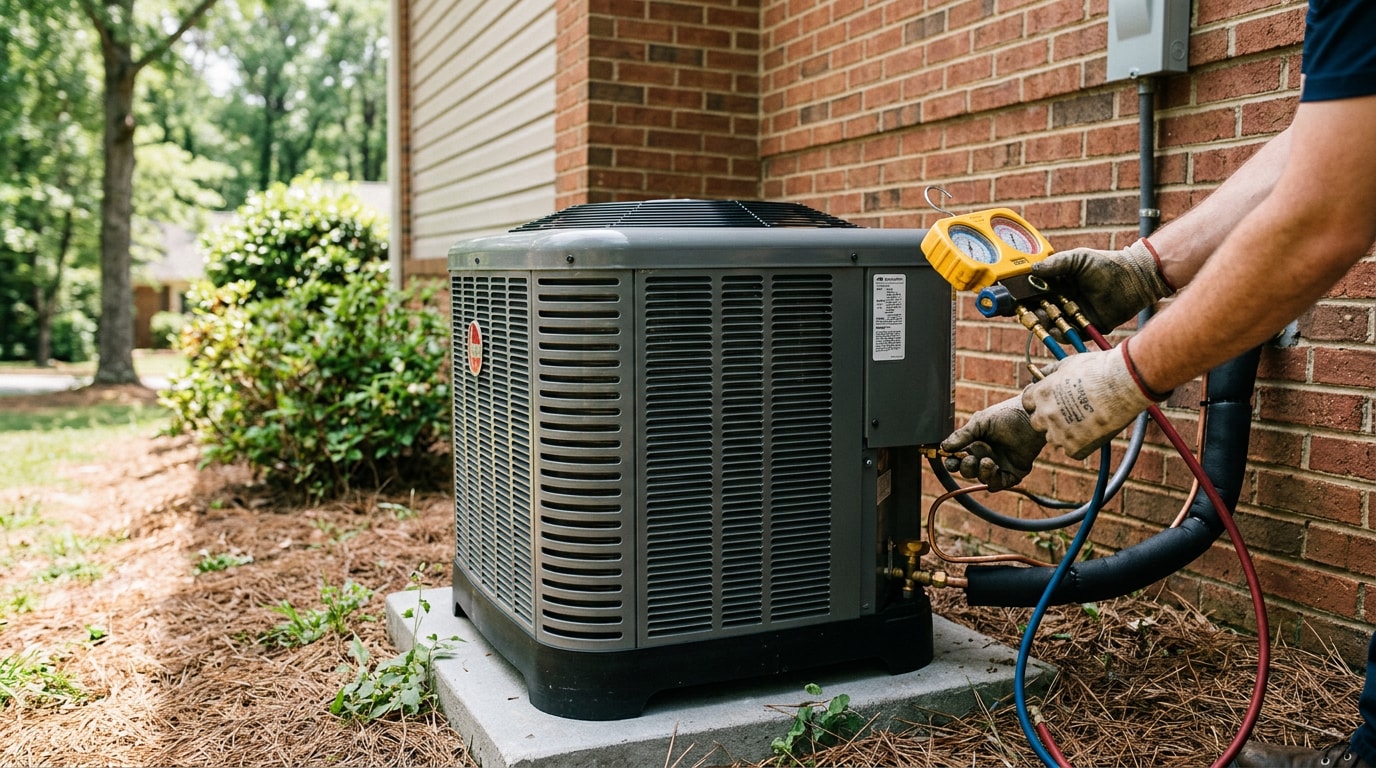
Clean the Outdoor Condenser Unit
Your outdoor condenser needs open airflow on all sides to release the heat your system pulls out of your home. When grass clippings, leaves, pollen, or overgrown shrubs crowd the unit, it can't shed heat efficiently, and cooling performance drops fast.
Homeowners can safely clear debris within two feet of the unit and gently hose off visible dirt from the fins, with the power switched off first. Deeper buildup inside the coil fins, or any bent fins, is better left to a technician since forcing a cleaning with too much pressure can damage the coil.
A related question we get constantly from Fayetteville homeowners: does hosing down the whole unit actually help it cool faster? We broke that down in detail in Does Spraying Water on an AC Unit Help Cool It? A Fayetteville, GA Answer.
Check for Blocked Vents
Furniture, rugs, curtains, and closed registers all restrict airflow room by room, even when the rest of the system is working fine. A couch pushed in front of a vent can make one room feel noticeably warmer than the rest of the house.
Closing vents in unused rooms to "save energy" is a common myth. It actually increases pressure in the ductwork and can strain the blower motor over time. Walk through each room and make sure registers are open and unobstructed.
Inspect the Ductwork
Uneven cooling from room to room, especially combined with a noticeably hot attic, often points to ductwork leaks rather than a problem with the unit itself. Air that escapes through gaps or disconnected joints never reaches your living space at all.
Check for disconnected or crushed ductwork, since improperly connected or crushed duct work can restrict airflow enough to make an otherwise healthy system feel weak. A full duct inspection generally isn't a weekend DIY project since sealing and insulating ducts properly takes the right materials and access to attic or crawlspace runs. Our Ductwork Sealing service handles exactly this kind of hot-and-cold-spot problem.
Clean the Evaporator Coils
The indoor evaporator coil is where your system actually absorbs heat from the air inside your home. It's easy to overlook because it sits hidden inside the air handler. A dirty or frozen coil is usually the downstream result of an ignored filter or an airflow problem further back in the system.
If you spot ice forming on the coil or refrigerant lines, turn the system off completely and let it thaw for several hours before testing it again. Running a frozen system continuously can push liquid refrigerant into the compressor, which is a far more expensive repair than a simple coil cleaning.
Check for Refrigerant Leaks
A refrigerant leak is the issue you least want behind an AC unit not blowing cold air, since it almost always requires a licensed technician to locate, repair, and recharge the system properly. Low refrigerant means the coil can't absorb heat the way it's designed to, no matter how clean everything else is.
Here's a detail most troubleshooting guides skip: as of 2026, R-410A systems are not banned and remain fully serviceable. A final EPA rule published in May 2026 allows the continued installation of HVAC units manufactured or imported before January 1, 2025 that use R-410A refrigerant, with that rule becoming effective July 27, 2026. That means your existing R-410A system can still be topped off and repaired through normal channels; it just shouldn't be repeatedly recharged without fixing the underlying leak. Technicians should locate and repair leaks instead of "topping-off" leaking systems , per guidance from the Air-Conditioning, Heating, and Refrigeration Institute.
Watch for hissing sounds near the lines, ice forming where it shouldn't, or a slow decline in cooling over several weeks. All are signs worth a professional diagnostic visit. If your system stops cooling entirely on a 95-degree afternoon, our Emergency Air Conditioning Repair and Refrigerant Recharge teams handle same-day calls across South Metro Atlanta. Leak detection and recharge costs vary widely depending on leak location and refrigerant amount, so expect a range rather than a flat number when you call for a quote.
Repair or Replace? How To Decide
Not every AC problem calls for a brand-new system. Deciding between repair and replacement usually comes down to four practical factors: the age of your equipment, how often you're calling for repairs, your current energy efficiency, and the cost comparison between fixing and replacing.
| Factor | Lean Toward Repair | Lean Toward Replace |
|---|---|---|
| System age | Under 10 years old | 12 to 15+ years old |
| Repair history | First service call this year | Two or more repairs in the past two years |
| Refrigerant type | R-410A, still fully supported | R-22, production discontinued |
| Energy bills | Stable year to year | Climbing noticeably each summer |
| Repair cost vs. replacement | Under 30% of a new system's cost | Over 50% of a new system's cost |
An aging AC unit paired with rising utility bills often costs more to keep patching than to replace with a higher-efficiency model. Central air conditioners are among the home improvements that can qualify for federal tax credits under current ENERGY STAR guidelines, which can offset part of the cost of upgrading. If you're weighing that decision, our Air Conditioning Installation page walks through what a new system install typically involves, and Air Conditioning Maintenance can extend the life of a system that still has a few good years left.
What Our Professional AC Repair Process Looks Like
Once the DIY checklist above is exhausted and the system still isn't cooling, a professional visit covers ground a homeowner can't easily check alone.
System inspection. A technician checks airflow at the vents and return, inspects electrical components like capacitors and contactors, measures refrigerant levels, and confirms the compressor and fan motor are operating correctly. This diagnostic visit usually takes less than an hour for most residential systems.
Accurate diagnosis. The goal is finding the actual root cause rather than guessing or swapping parts that don't need replacing. Our EPA Section 608 certified technicians walk you through what's wrong and why before any repair work begins, so you're not paying for parts your system didn't need.
In our experience running service calls throughout Henry County, the two fastest fixes are also the two most commonly skipped: the thermostat fan setting and the filter. We've shown up to calls expecting a compressor failure and found nothing more than a filter clogged tight enough to trip the system's safety switch.

If your system is still blowing warm air after working through this list, schedule a free inspection and we'll get a technician out to diagnose it properly. We serve homeowners throughout Henry County, Fayetteville, McDonough, and the rest of South Metro Atlanta, and you can read more about how a typical emergency call plays out in Emergency Air Conditioning Repair in Henry County, GA: What to Expect When You Call.
FAQ
How Long Does an AC Repair Take?
Most common repairs finish within a single visit once the technician identifies the issue. Simple fixes like a capacitor swap or filter-related repair are often same-day, while repairs needing a special-order part can take longer depending on availability.
Is It Worth Repairing My AC Unit?
It depends on the same four factors covered above: age, repair frequency, efficiency, and cost. A rough rule of thumb many technicians use is that if a repair costs more than half the price of a new system on an aging unit, replacement usually makes more financial sense.
Should I Turn Off My AC If It's Not Blowing Cold Air?
Turn the system off if you notice ice on the coils or lines, or if the breaker keeps tripping repeatedly. Continuing to run it in either case risks more expensive damage. If it's simply blowing warm air without those warning signs, it's generally safe to keep troubleshooting before shutting it down.
How Much Does It Cost to Fix an AC That's Not Blowing Cold Air?
Costs vary widely depending on the cause. A thermostat or filter fix typically costs very little, mid-range repairs like capacitors or coil cleaning fall in the middle, and compressor or refrigerant leak repairs sit at the higher end. The exact number depends on your specific system and the part involved, so a technician visit is the only way to get an accurate quote.
Why Is My AC Running But Not Cooling the House?
This usually points to airflow loss rather than a broken unit: leaky ductwork, a dirty filter, or blocked vents are the most common culprits. Leaks in refrigerant lines also reduce cooling performance and increase energy consumption , so if the ducts and filter check out clean, a refrigerant check is the next step.
What Temperature Should Air Coming From My Vents Be?
Most HVAC technicians consider air that's 15 to 20 degrees cooler than your return air temperature to be normal for a healthy system. If the gap is smaller than that, something in the cooling cycle, not just the fan, needs attention.