Does spraying water on an AC unit help cool it down during a Fayetteville, GA heat wave? Yes, for a few minutes, through plain evaporative cooling, but the relief disappears the moment the coils dry and it won't fix a system that's already struggling in August humidity. Here's what the water actually does to your condenser, why it underperforms in Georgia compared to a dry climate, and when a garden hose should hand the job off to a technician.
How Your Fayetteville AC System Actually Cools Your Home
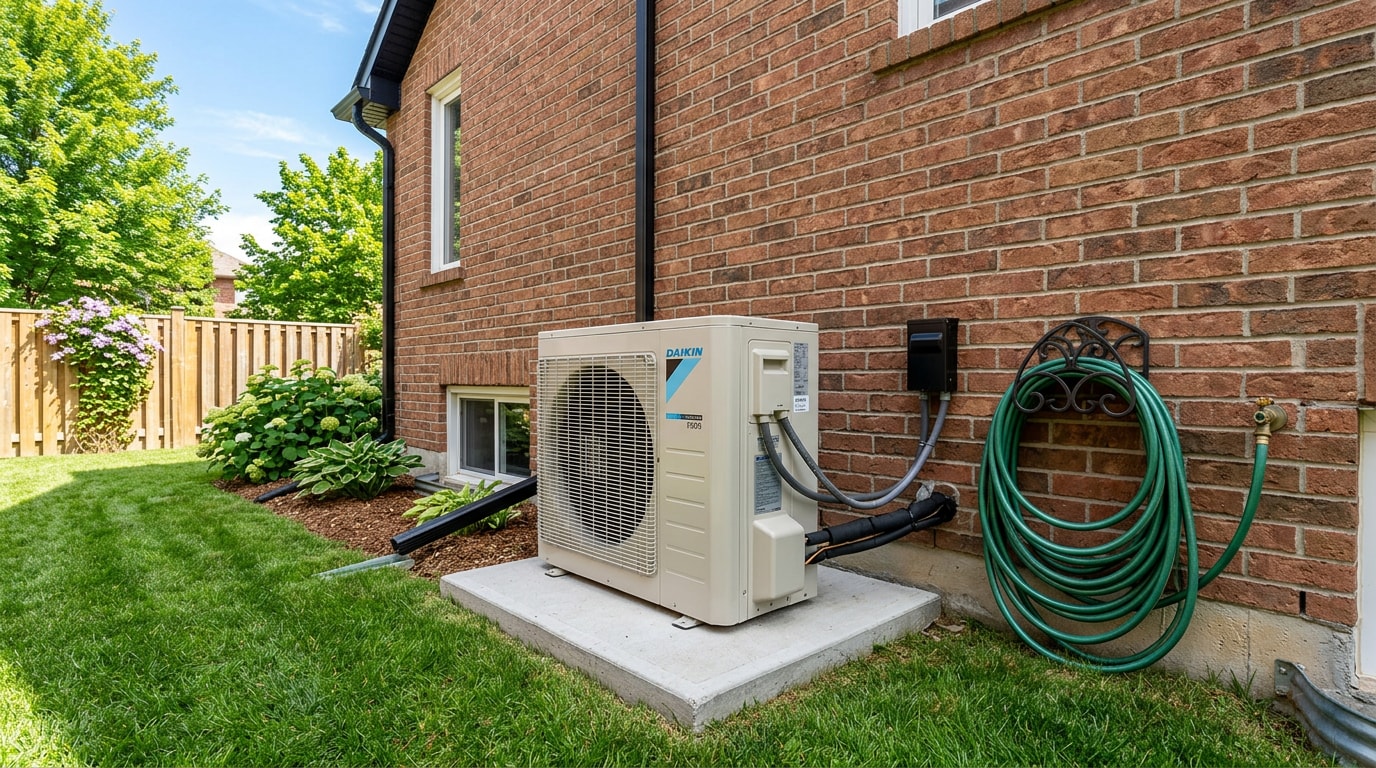
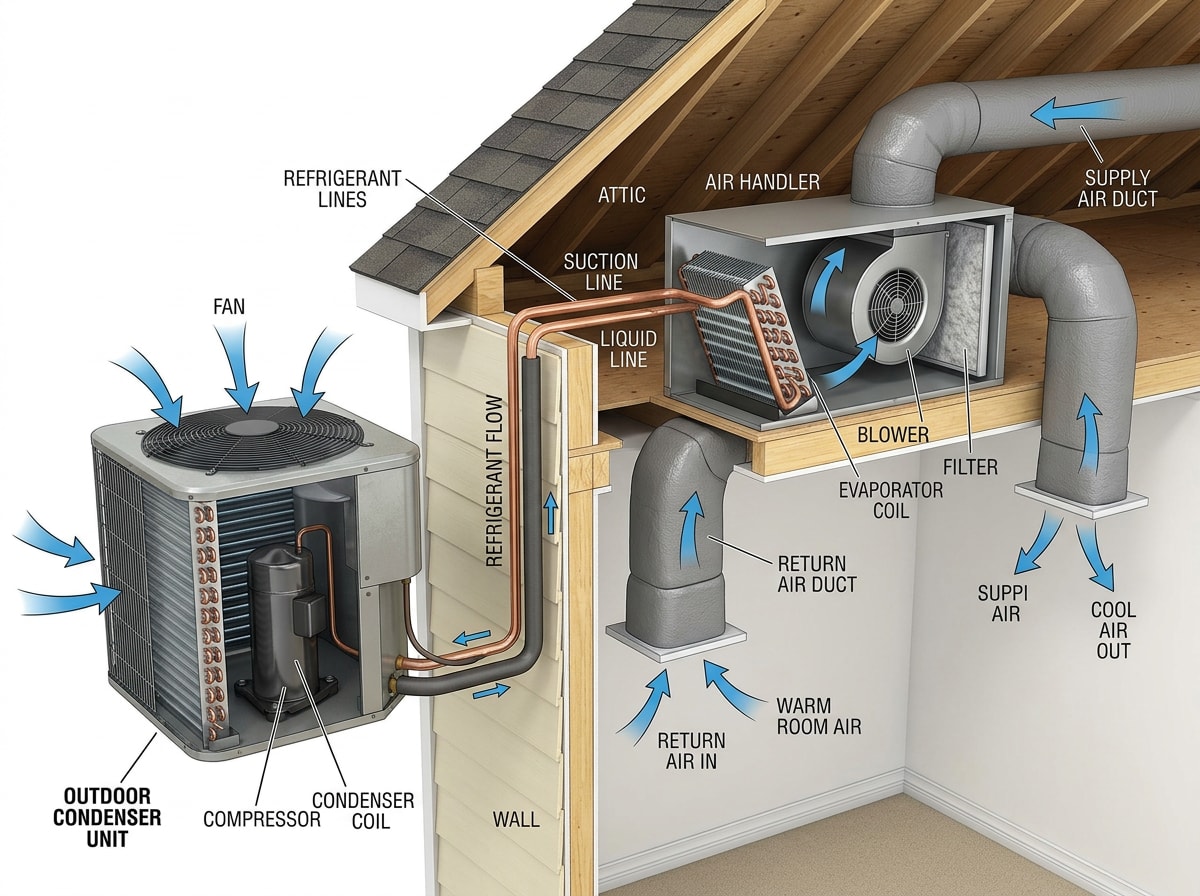
Your central air conditioner moves heat, it doesn't manufacture cold. Refrigerant absorbs heat from indoor air, carries it outside through copper lines, and releases it at the outdoor condenser. A fan pulls outside air across those coils so the heat transfer happens fast.
On a 95-degree Fayetteville afternoon, that outside air is already so warm it can't absorb much more heat from the coils. The condenser runs longer cycles just to hold the line, and that's exactly the moment homeowners reach for the hose.
The Science Behind Spraying Water on an AC Unit
Spraying water on a hot condenser triggers evaporative cooling. The liquid rapidly absorbs heat energy from the surface to change into water vapor, which draws thermal energy away from the refrigerant lines and temporarily lowers the refrigerant temperature.
That temporary cooling causes a drop in the system's high-side pressure, letting the compressor work against less resistance, so the unit briefly runs more efficiently.
Here's the part most quick-tip articles skip. On systems that use a fixed-orifice metering device instead of a thermostatic expansion valve, that pressure drop isn't a free win. Veteran technicians on HVAC trade forums have pointed out that spraying water on the outdoor coil lowers the head pressure, which means a lower pressure difference and lower refrigerant flow through a fixed orifice , so cooling capacity can actually drop even as the compressor draws less power. In other words, your amps go down, but your BTUs of actual cooling don't automatically go up the way the hack implies.
The effect is short-lived either way, because the water evaporates quickly, and once it's gone the condenser's temperature climbs right back to its original, less efficient operating point. A fine mist evaporates faster and more evenly across the coil than a heavy hose stream, which tends to pool at the base instead.
Why Fayetteville's Humidity Changes the Math
Evaporative cooling depends on how much moisture the surrounding air can still absorb. Dry air pulls water vapor away quickly and carries more heat with it. Metro Atlanta's thick summer humidity is already close to saturated most afternoons, so water sitting on a condenser coil here evaporates slower and pulls less heat than the same trick would in Phoenix or Las Vegas. That's one reason the "spray it down" advice that circulates online rarely delivers the dramatic bill savings people expect in a Georgia climate.
The Real Risks of Making This a Habit
An occasional rinse to clear pollen or grass clippings is fine. Turning water spraying into a daily cooling ritual is a different story, and it can shorten your system's lifespan.
- Mineral scale.
Routine water application risks mineral scale on the coil fins, especially with hard water, because as the water evaporates it leaves behind dissolved solids like calcium and magnesium that build up on the metal surface. That scale insulates the coil and forces the compressor to work harder, the opposite of the relief you were after.
- Corrosion and mildew. Standing moisture around the unit's base can encourage rust and mildew growth near electrical components over time.
- Refrigerant imbalance. On older fixed-orifice systems, repeated water spraying without a technician adjusting charge can leave the system running outside its designed pressure range.
Residential condensers are air-cooled by design. They're built to reject heat through airflow, not through a standing water film, which is why commercial water-cooled systems use treated, filtered loops instead of a garden hose. If your unit struggles every single summer afternoon, that's a sign for a proper air conditioning maintenance visit, not a bigger hose.
One field-tested exception: some technicians have used a temporary water spray on a corroded, failing outdoor coil as a stopgap to keep a unit running for a couple more weeks while a replacement part was on order , not as a permanent fix. That's a technician's emergency bridge, not a homeowner cooling strategy.
Safe Ways to Use Water on Your AC Unit
If you do rinse the condenser, do it the right way:
- Turn off power at the outdoor disconnect box before you start.
- Use a garden hose on moderate pressure, spraying from the inside of the unit outward to push debris away rather than deeper into the fins.
- Avoid aiming water directly at the electrical panel or fan motor housing.
- Let the unit air-dry and restore power only once everything is dry to the touch.
- Limit this to once or twice a season, paired with a scheduled tune-up.
That last point matters more than it sounds. OSHA's guidance on electrical equipment is blunt about mixing water and live components: never operate electrical equipment while standing in water , and have a qualified electrician inspect any electrical equipment that has gotten wet before energizing it. That's exactly why the disconnect box, not the hose nozzle, is step one.
Hose Rinse vs. Professional Service
| DIY Hose Rinse | Professional Coil Cleaning | |
|---|---|---|
| Removes surface debris | Yes, loose dirt and pollen | Yes, plus compacted grime |
| Reaches inner coil fins | Limited | Full access with coil comb and cleaner |
| Checks refrigerant charge | No | Yes |
| Identifies electrical risks | No | Yes |
| Recommended frequency | 1–2 times per season | Once per year |
Dirty coils reduce a system's ability to cool the home and cause it to run longer, which increases energy costs and reduces the equipment's life , so a thorough annual cleaning tends to matter more for your bill than any amount of afternoon spraying.
When to Call a Professional Instead of Reaching for the Hose
If your Fayetteville home still runs warm after a rinse, the water hack isn't the problem, something underneath it is. Low refrigerant, a failing capacitor, or a coil that's scaled over from years of hard water can all masquerade as "the AC just can't keep up with summer." A U.S. Department of Energy review of residential HVAC field studies found that routine tune-ups produced roughly 5% incremental energy savings , savings a garden hose can't replicate.
At Help Your AC, we've walked into plenty of Fayetteville service calls where a homeowner had been spraying the condenser every afternoon for weeks before calling, and the real issue was a refrigerant charge that had drifted low months earlier. If your system is short on refrigerant, a proper refrigerant recharge solves it in one visit instead of a summer of hose duty. For a system that's limping along entirely, air conditioning repair gets to the actual cause, and if it quits altogether on the hottest day of the year, emergency air conditioning repair is built for exactly that.
We serve homeowners throughout Fayetteville, GA and the surrounding south metro area, so if your AC has been struggling despite your best DIY efforts, schedule a free inspection and we'll tell you honestly whether it's a cleaning issue, a charge issue, or something bigger.
FAQ
Does spraying water on an AC unit help it cool?
Yes, briefly. It triggers evaporative cooling that lowers condenser temperature for a few minutes. The effect disappears as soon as the water dries off the coils, and on some systems it can even reduce refrigerant flow rather than boost cooling.
Can you spray water on your AC unit?
Yes. Outdoor condensers are built to handle rain and weather exposure, so a hose rinse won't damage the unit itself. Just avoid spraying directly into the electrical disconnect box or fan motor housing.
Is it good to spray your AC unit with water?
An occasional rinse to clear debris is good for airflow and efficiency. Spraying water routinely as a cooling strategy isn't recommended, since it can lead to mineral scale and corrosion over time.
Does hosing down an AC unit help?
Mostly by removing dirt and debris that block airflow across the coils, which restores normal efficiency. Any extra cooling from the water itself is a minor, short-lived bonus, not the main benefit.
How often should you rinse your AC condenser?
Once or twice per cooling season is plenty for most homes, paired with a professional tune-up. More frequent spraying raises the risk of mineral scale without adding real cooling capacity.
---
This guide was reviewed by the licensed technicians at Help Your AC, serving Fayetteville, GA and the south metro Atlanta area. Questions about your specific system? Contact us and we'll walk through it with you.