Searching for "commercial HVAC companies near me" usually means one thing: a system is already struggling in a Spalding County warehouse, restaurant, or office, and you need a contractor who can handle commercial-grade equipment, not just a home AC tune-up. The right call now saves you from a repeat visit, a code violation, or a shutdown during a Georgia summer. Here's exactly what to check before you hand anyone the job.
How to Find Commercial HVAC Companies Near Me in Spalding County, GA
Start with a short list, not a single name. Pull together three to five contractors who actually serve Griffin and Spalding County and who work regularly on commercial systems, not just residential units.
Use these filters to build that list fast:
- Service area match – confirm they list Spalding County or Griffin specifically, not just "Metro Atlanta" in general.
- Commercial-specific pages – a real commercial HVAC provider has a dedicated commercial services page, not a single paragraph bolted onto a residential site.
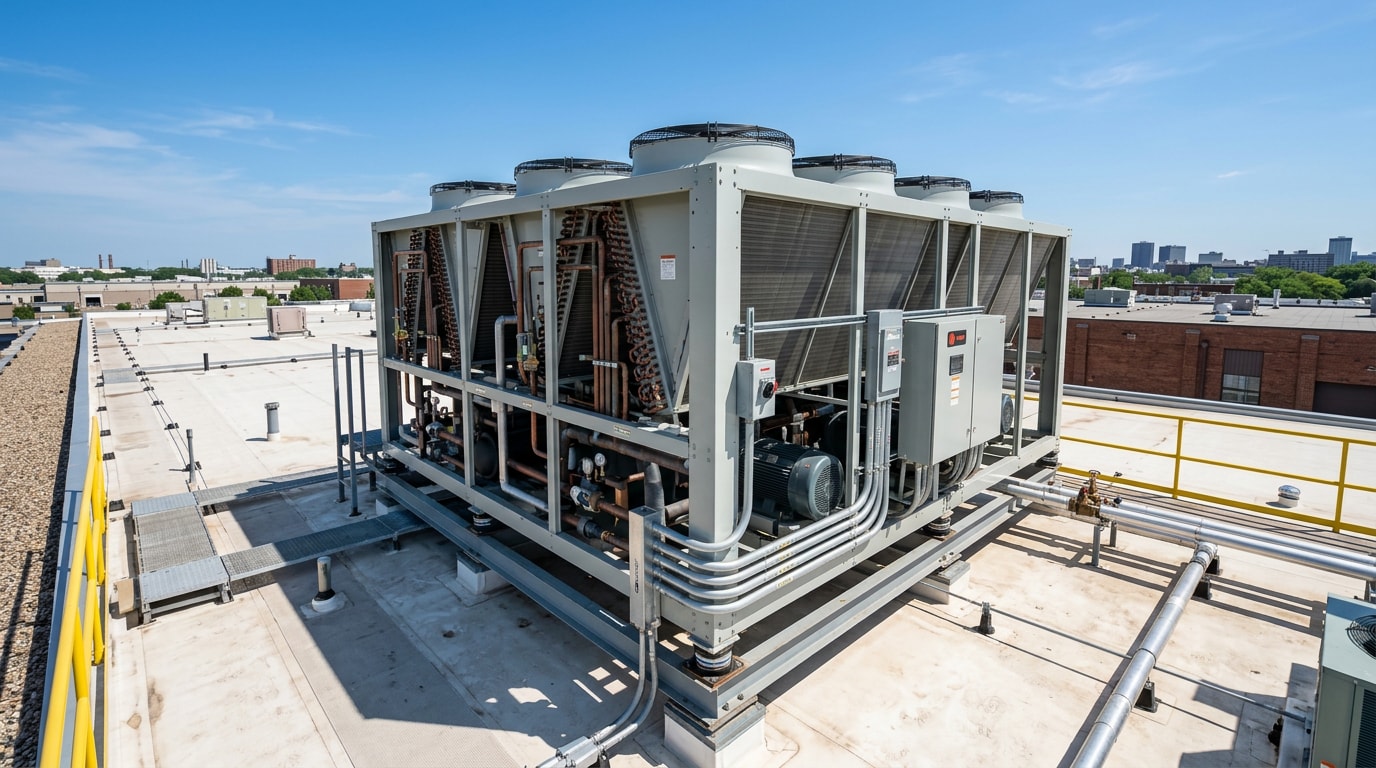
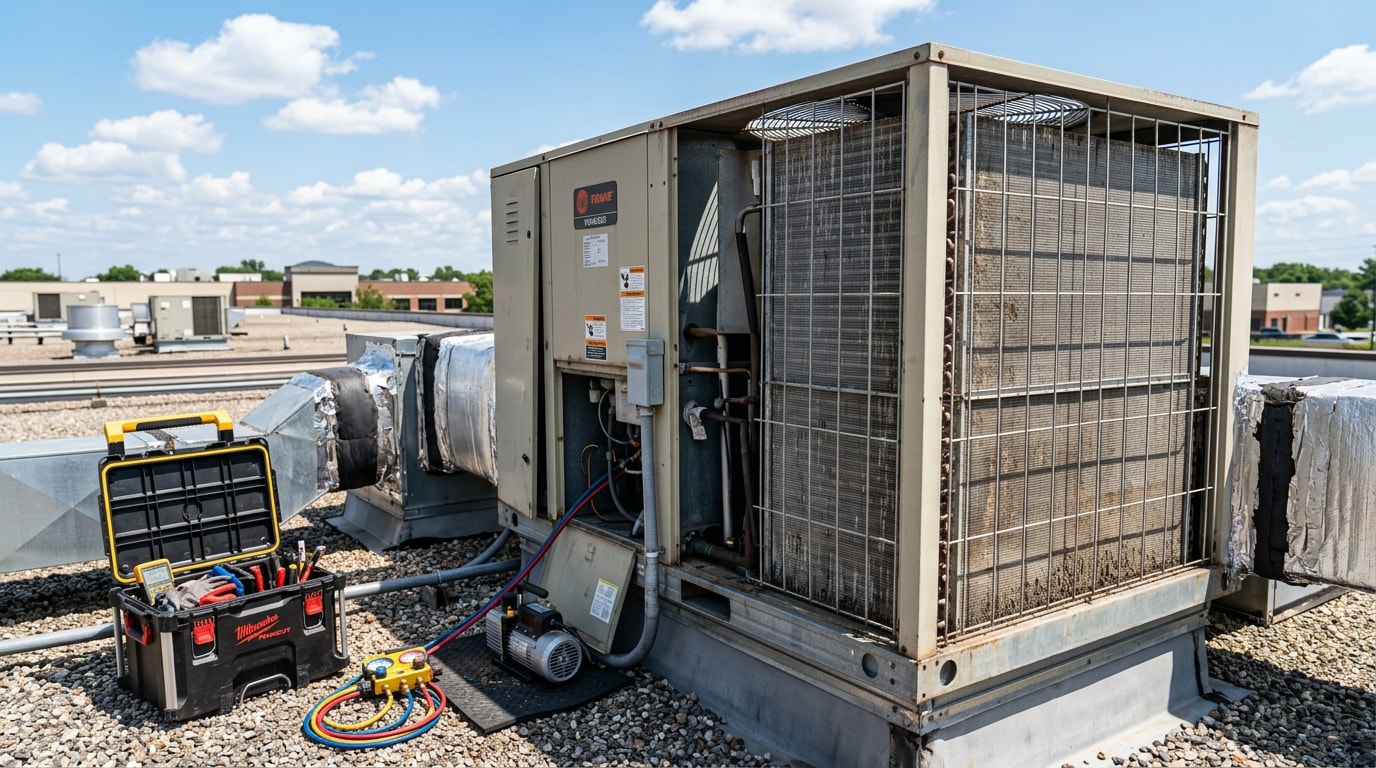
- Equipment named by type – look for mentions of rooftop units (RTUs), VRF systems, chillers, or make-up air units, not just "AC repair."
- Licensing visible – a Georgia license number should be easy to find on the site or in the Google Business Profile.
- Local reviews – reviews that mention offices, restaurants, or industrial clients, not just home tune-ups.
Once you have your shortlist, the real vetting starts.
Why Your Choice of Commercial HVAC Contractor Matters
Picking a commercial HVAC partner carries more weight than hiring someone for a home repair. Commercial space conditioning, meaning heating, cooling, and ventilating, accounts for about 7.0 quads of primary energy per year, or about 40% of total commercial energy use in the United States. That single line item is often the easiest place for a business to either waste money or save it.
For Griffin restaurants, medical offices, and warehouses, a poorly maintained system doesn't just waste money. It threatens energy efficiency, compliance with refrigerant and safety regulations, and basic business continuity during peak season. A contractor who understands commercial HVAC service and repair work can catch problems a residential-focused tech would miss entirely.
Vet Commercial-Specific Experience Before You Call
Ask About Their Commercial vs. Residential Workload
A contractor who spends most of their time on home air conditioners is rarely the right fit for rooftop units, VRF systems, or the shared equipment found in multi-tenant buildings. Commercial systems involve different electrical loads, ductwork scale, and controls logic than a typical house.
In Griffin, that distinction shows up in real terms. A manufacturing facility off Highway 16 has different needs than a retail strip near downtown or a medical office with strict temperature and humidity requirements. Ask directly how much of a contractor's workload is commercial versus residential. The answer tells you how prepared their team actually is for your building type.
Check Their Digital Footprint
Check a company's website and Google Business Profile for real evidence of commercial work, including project photos, case studies, and certifications displayed clearly, not just a logo and a phone number. This quick check filters out contractors who list "commercial" as an afterthought on an otherwise residential-focused site.
Look for Google reviews that specifically mention office buildings, restaurants, or industrial clients, not just home AC tune-ups. A legitimate HVAC contractor page should show completed jobs, licensing information, and the types of equipment the team services. If a company's online presence is thin on commercial details, that's usually a sign their experience is thin too.
Confirm Licensing and Certifications (Non-Negotiable)
Once your shortlist is narrowed down, licensing, certifications, and documented experience become the real deciding factors.
Georgia Licensing
To perform any type of HVAC contracting work in Georgia, a contractor must be a licensed Conditioned Air Contractor.
This classification covers the installation, service, and replacement of heating and cooling systems, ductwork, refrigerant-handling equipment, and related components in both residential and commercial structures, and licensure is mandatory before any contractor may legally perform this work for compensation in Georgia.
You can confirm a contractor's license status directly through the Georgia Secretary of State's Conditioned Air Contractor licensing guide before signing anything. Skipping this step leaves your business exposed. Unlicensed work can void insurance claims and create liability issues that fall back on the property owner, not the contractor.
EPA Section 608 and NATE Certification
Two credentials are worth asking about by name: NATE certification and EPA Section 608 refrigerant handling certification. NATE-certified technicians have passed standardized testing on HVAC systems, and EPA 608 is a federal requirement.
EPA regulations under Section 608 of the Clean Air Act require that technicians who maintain, service, repair, or dispose of equipment that could release ozone-depleting refrigerants into the atmosphere must be certified. Georgia's own licensing board backs this up: a valid EPA certification for refrigerant handling is required before a contractor can even file their state license application.
The EPA's official Section 608 certification page outlines exactly what the certification covers and why it's required, not optional. Asking a company how many of their technicians hold both credentials is a fast way to separate serious commercial contractors from generalists.
| Credential | What It Covers | How to Verify |
|---|---|---|
| Georgia Conditioned Air Contractor License | Legal authority to perform HVAC work in Georgia | Georgia Secretary of State license lookup |
| EPA Section 608 | Federal refrigerant handling requirement | Ask for a copy of the technician's certification card |
| NATE Certification | Standardized technical competency testing | Ask how many technicians hold current NATE certification |
| General Liability & Workers' Comp Insurance | Protects you if something goes wrong on-site | Request a certificate of insurance before work begins |
Judge Real-World Experience, Not Just Paperwork
Credentials tell you a technician passed a test. They don't prove field experience on buildings like yours. Ask for two or three reference projects similar in size and system type to your facility, and ask what went wrong and how it was handled.
Our commercial crews in the Griffin area have run RTU swaps on retail buildings timed around tenant hours and coordinated refrigerant line work around a restaurant's dinner rush, the kind of scheduling detail that only comes up once you've actually worked these buildings. That kind of specifics is hard to fake and tells you more than any brochure.
Technical Capabilities Still Matter
A contractor's team should keep up with ongoing training as HVAC technology evolves, not rely on equipment they learned on years ago. Ask whether technicians are trained on current refrigerants, variable-speed equipment, and modern controls, since older training alone won't cover what's installed in most newer commercial buildings today. A provider offering full HVAC maintenance plans is usually a sign they're set up for ongoing relationships, not one-off service calls.
Local Coverage: Why Spalding County Experience Matters
A contractor already working across Spalding County brings advantages a distant national provider can't match. Griffin's humid summers put real strain on commercial systems, and local technicians who service this climate regularly know how to size and maintain equipment for it.
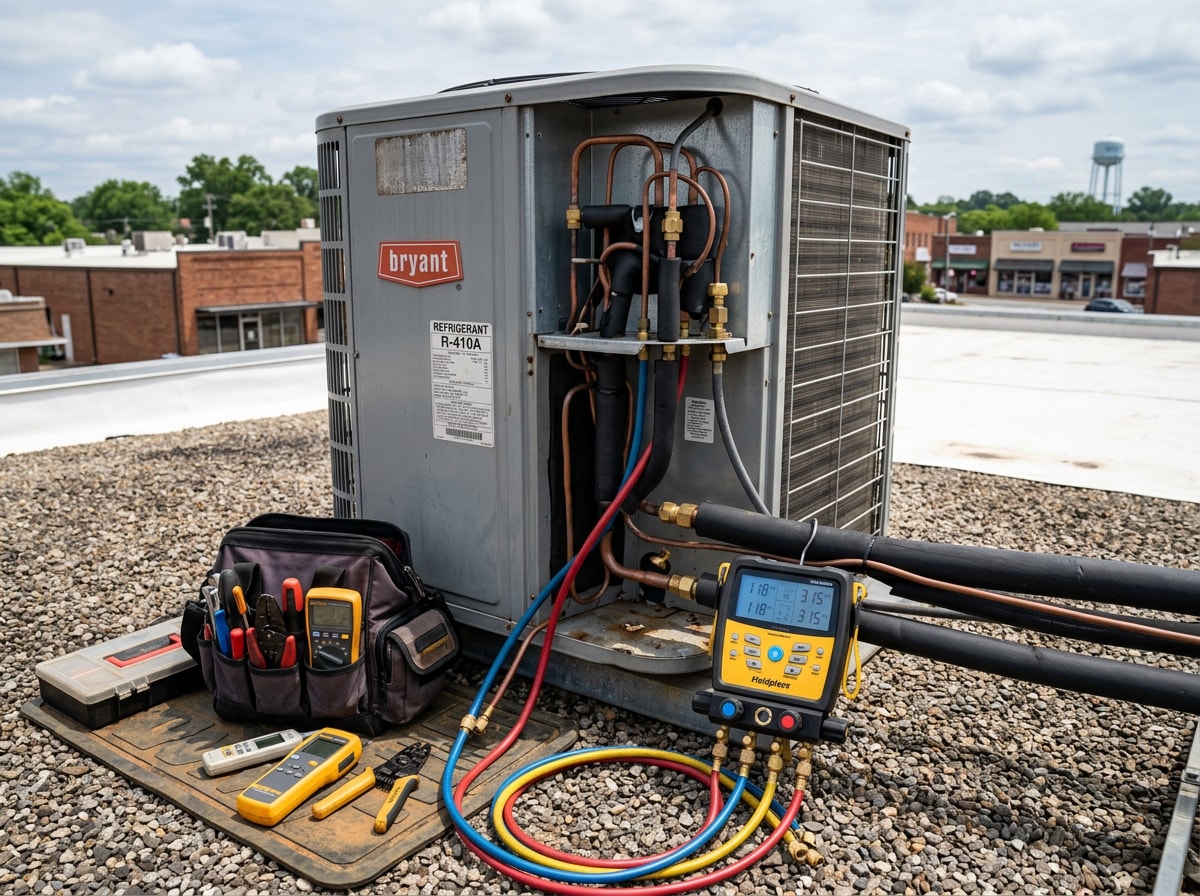
Spalding County's mix of manufacturing plants, retail centers, and office buildings each come with their own equipment demands and permitting requirements. A local contractor already familiar with county code and inspection processes can usually respond faster during an emergency and avoid the delays that come with permit unfamiliarity. Check a company's Spalding County, GA service area coverage directly before assuming they're a true local option. If an emergency hits after hours, it also helps to know what to expect when you call for emergency repair ahead of time, since the process is similar across our service area.
Commercial vs. Residential HVAC: Quick Comparison
| Factor | Commercial HVAC | Residential HVAC |
|---|---|---|
| Typical equipment | RTUs, VRF systems, chillers | Split systems, heat pumps |
| System scale | Serves multiple zones or tenants | Serves a single household |
| Electrical load | Higher voltage, three-phase common | Standard residential circuits |
| Code & inspection | Often more complex, commercial permitting | Simpler residential permitting |
| Maintenance frequency | Seasonal or quarterly, higher usage | Typically twice a year |
Final Thoughts: Choosing Your Commercial HVAC Partner in Spalding County
Finding the right fit comes down to three things: verified credentials, real commercial-specific experience, and a genuine local presence in Spalding County. That applies whether you need a repair, a full installation, a replacement, or an ongoing maintenance plan.
Once a contractor checks all three boxes, you've likely found a partner worth calling first. If you'd rather skip the vetting process entirely, schedule a free inspection with a team that already works across Spalding County, or visit the HelpYourAC homepage to see our full service lineup.
This guide was reviewed by a NATE-certified lead technician on HelpYourAC's commercial team who has handled rooftop unit and refrigerant-line projects across Griffin and Spalding County. Questions about your specific building? Contact us directly.
FAQ
How do I find a reliable commercial HVAC company near me in Spalding County, GA?
Build a shortlist of three to five contractors who specifically serve Spalding County and work on commercial systems. Then verify licensing, insurance, NATE and EPA 608 certifications, and documented commercial-specific experience with buildings similar to yours before scheduling a visit.
Do Georgia commercial HVAC contractors need to be licensed?
Yes. To perform any type of contracting work, a technician must hold a licensed Conditioned Air Contractor credential issued through the Georgia Secretary of State. Always confirm the license is active before work begins.
How much does commercial HVAC installation or repair cost?
Costs vary widely based on building size, equipment type, and whether you need a repair or a full RTU replacement. Rooftop unit installation typically ranges from several thousand dollars for a single unit to significantly more for multi-unit or chiller-based systems. Get a written estimate before work starts.
What is the difference between commercial and residential HVAC?
Commercial systems are larger in scale and often use rooftop units or VRF systems instead of simple split systems. They're also more complex, frequently serving multiple zones or tenants within one building, which requires different design and maintenance expertise.
How often should commercial HVAC systems be serviced?
Most commercial systems benefit from seasonal or quarterly maintenance visits. Buildings with heavy usage, like restaurants or medical facilities, may need more frequent checkups to avoid unexpected downtime.
What should I ask before hiring a commercial HVAC company near me?
Ask for proof of Georgia licensing, EPA 608 and NATE certifications, insurance documentation, and two or three reference projects similar to your building type and size. A contractor who answers these quickly without hesitation is usually the safer bet.